
TB & Respiratory Infections
HAI & Other Infectious Diseases
STIs
Emerging Infectious Diseases
Media
EN
2026.06.05
On June 1, 2026, China's National Health Commission (NHC), together with the National Administration of Traditional Chinese Medicine, officially released the updated Diagnosis and Treatment Protocol for Ebola Virus Disease (2026 Edition). This marks the first major revision since the original 2014 guideline was issued twelve years ago. The updated protocol reaffirms nucleic acid testing (NAT) as the gold standard for confirming Ebola virus disease during the acute phase and provides comprehensive guidance on screening and differential diagnosis of suspected cases.
According to data released by the Ministry of Health of the Democratic Republic of the Congo (DRC) on June 2, the country has reported a cumulative total of 344 confirmed Ebola cases as of June 1, including 60 deaths and six recoveries. In neighboring Uganda, confirmed cases have risen to 15, with one reported death. Meanwhile, eleven surrounding African countries have been classified as high-risk by the Africa Centres for Disease Control and Prevention (Africa CDC). Several countries, including the United States, Canada, Germany, the United Kingdom, and France, have strengthened border control measures as concerns over cross-border transmission continue to grow.
The World Health Organization (WHO) has warned that the outbreak poses a serious threat to regional and international public health.
Nucleic Acid Testing Confirmed as the Gold Standard
Ebola virus disease has an incubation period of 2–21 days, and infected individuals may shed virus before symptoms become apparent. Early clinical manifestations—including fever, fatigue, vomiting, and diarrhea—closely resemble those of many other tropical infectious diseases. As a result, rapid and accurate molecular testing is essential for early case detection, timely isolation, and outbreak containment.
The updated protocol identifies three primary laboratory diagnostic approaches:
Nucleic Acid Amplification Testing (NAAT)
Reverse transcription polymerase chain reaction (RT-PCR) and related methods can detect viral RNA in blood samples during the acute phase and remain the gold standard for laboratory confirmation.
Antigen Detection
Enzyme-linked immunosorbent assay (ELISA)-based antigen testing may support rapid early screening.
Virus Isolation
Primarily reserved for confirmatory testing in high-containment biosafety laboratories.
Importantly, the guideline also highlights the need for differential diagnosis. Ebola virus disease should be distinguished from malaria, typhoid fever, cholera, Marburg virus disease, dengue fever, and other febrile illnesses. The protocol specifically notes that co-infections are common in Ebola-endemic regions, particularly malaria, and recommends screening for other locally prevalent infectious diseases even when Ebola viral RNA is detected.
This recommendation underscores a critical clinical reality: when evaluating a febrile patient at a screening checkpoint in an outbreak area, testing for Ebola alone may not be sufficient. Multiplex pathogen detection capabilities are increasingly important for accurate diagnosis and patient management.
Escalating Outbreak Highlights Limitations of Conventional Testing
In May 2026, WHO declared the current Ebola outbreak a Public Health Emergency of International Concern (PHEIC). As modern air travel accelerates the movement of infectious diseases across borders, countries are facing growing challenges in entry screening, border surveillance, and rapid response preparedness.
However, traditional laboratory-based molecular testing presents several limitations in frontline outbreak response settings:
Time-Consuming Testing Workflow
Conventional qPCR testing requires multiple manual steps, including sample inactivation, nucleic acid extraction, reagent preparation, and amplification. The complete process often takes three to four hours, making it difficult to support rapid screening at airports, border checkpoints, and emergency response sites.
Dependence on Laboratory Infrastructure
Traditional PCR instruments are typically large, complex, and reliant on stable power supplies and laboratory facilities. Their deployment in remote outbreak zones, rural healthcare facilities, and border control points remains challenging.
Requirement for Highly Trained Personnel
Molecular testing workflows generally require skilled laboratory professionals. In many outbreak-affected regions, frontline healthcare workers may have limited molecular diagnostic training, restricting testing capacity.
Elevated Biosafety Risks
Multiple manual handling and open-tube procedures increase the risk of cross-contamination and operator exposure, potentially compromising result accuracy and biosafety.
Coyote FlashDetect™:
A Fully Automated Molecular POCT Solution for Ebola Screening
Leveraging its expertise in molecular diagnostics for emerging and re-emerging infectious diseases, as well as experience gained through national research initiatives, Coyote Bioscience has developed a comprehensive Ebola testing solution combining the FlashDetect™ Ebola Virus Nucleic Acid Detection Kit with its fully automated molecular point-of-care testing (POCT) platform.
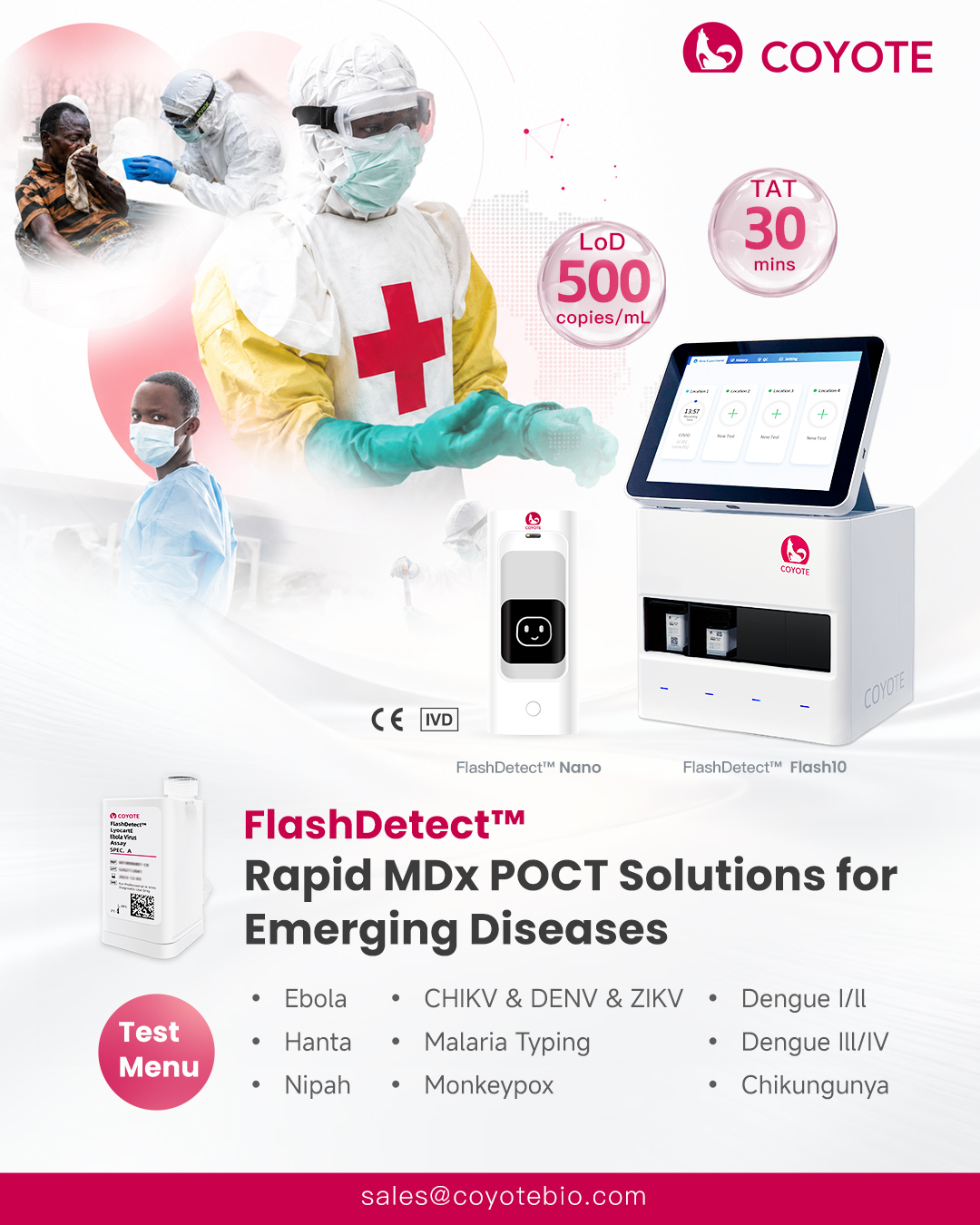
The solution integrates the entire PCR workflow—from sample preparation and nucleic acid extraction to amplification and result interpretation—into a compact instrument and fully enclosed test cartridge, effectively bringing laboratory-grade molecular diagnostics directly to the point of need.
Designed for deployment in outbreak hotspots, border checkpoints, mobile testing units, field hospitals, and remote healthcare settings, the FlashDetect™ platform enables rapid, accurate, and decentralized molecular testing, helping public health authorities strengthen frontline surveillance and contain cross-border transmission risks.
FlashDetect™ Ebola Virus Nucleic Acid Test Kit
Precise Detection. Enhanced Biosafety.
The FlashDetect™ Ebola Virus Nucleic Acid Test Kit is specifically designed to target highly conserved regions of the Ebola virus genome, enabling rapid and accurate molecular detection of Ebola virus infection. The assay offers several key advantages for frontline outbreak response:
Fully Enclosed Testing Workflow for Maximum Biosafety
The entire testing process is conducted within a fully enclosed cartridge, eliminating the need for manual nucleic acid extraction, purification, reagent preparation, or sample transfer. Following sample inactivation, specimens can be loaded directly into the system for automated processing.
This closed-cartridge design minimizes the risk of cross-contamination and operator exposure, significantly enhancing biosafety for healthcare workers and laboratory personnel operating in outbreak settings.
Gold-Standard Molecular Technology for Reliable Results
The assay combines magnetic bead-based nucleic acid extraction with real-time quantitative PCR (qPCR), delivering the performance of laboratory-grade molecular diagnostics in a field-deployable format.
With a limit of detection (LoD) as low as 500 copies/mL, the assay demonstrates excellent analytical performance, achieving 99% sensitivity and 98% specificity compared with conventional laboratory qPCR methods, helping to reduce the risk of false-positive and false-negative results.
Extensive analytical validation has demonstrated no cross-reactivity with other Ebola virus species or with 22 common respiratory and gastrointestinal pathogens. This high specificity enables accurate differentiation between Ebola virus disease and other febrile tropical infections such as dengue fever and chikungunya, supporting more precise clinical decision-making and outbreak management.
FlashDetect™ Automated Molecular POCT System
Redefining Rapid Testing at the Point of Need
The FlashDetect™ molecular point-of-care testing (POCT) platform includes the portable single-sample FlashDetect™ Nano and the higher-throughput FlashDetect™ Flash10 system.
Developed based on years of frontline outbreak-response experience and multiple national research initiatives, the platform represents a new generation of fully automated molecular diagnostics designed specifically for decentralized testing environments. It is among the few fully automated nucleic acid testing systems in China that truly meets POCT requirements.
Fully Automated Sample-to-Answer Workflow
The system integrates patient registration, sample loading, nucleic acid extraction, amplification, result interpretation, and automated reporting into a single workflow.
No specialized molecular laboratory expertise is required. After minimal training, healthcare workers can independently perform testing, helping address the shortage of highly trained personnel often encountered in outbreak regions and remote healthcare settings.
Rapid Results in Approximately 30 Minutes
The FlashDetect™ platform delivers results in approximately 30 minutes per sample—up to four times faster than conventional laboratory PCR workflows.
This accelerated turnaround time enables faster patient triage, earlier isolation decisions, and more effective contact tracing during outbreak response.
Flexible Deployment Across Diverse Testing Scenarios
The compact FlashDetect™ Nano is lightweight, backpack-portable, and can operate using a mobile power source. It requires no recalibration after transport, making it ideal for field hospitals, border checkpoints, mobile laboratories, and remote healthcare facilities where laboratory infrastructure is limited.
For higher testing demand, FlashDetect™ Flash10 features four independent testing modules capable of running different assays simultaneously. This flexible architecture supports both sporadic testing and large-scale screening programs at ports of entry, fever clinics, quarantine facilities, and outbreak surveillance centers.
Multiplex Pathogen Testing to Support Differential Diagnosis
Beyond Ebola virus detection, Coyote Bioscience has established a comprehensive molecular testing portfolio covering a range of high-priority infectious diseases, including dengue fever, malaria, chikungunya, and other emerging pathogens.
The platform's multi-pathogen testing capability aligns closely with the recommendations outlined in the latest Ebola clinical management guidelines, enabling differential diagnosis and co-infection screening within a single testing workflow. This helps reduce diagnostic uncertainty while improving outbreak surveillance and patient management.
National Innovation. Proven in the Field.
Advancing Infectious Disease Diagnostics Through National Research Programs
Coyote Bioscience's technological leadership is built upon years of participation in major national infectious disease research initiatives.
In 2018, the company undertook a National Major Science and Technology Project for Infectious Diseases and successfully completed validation studies with China's National Influenza Center, establishing an integrated molecular diagnostic solution for emerging infectious disease response.
In 2023, Coyote participated as a core contributor to the national project "Development and Application of Key Technologies for Prevention and Control of Emerging Viral Respiratory Infectious Diseases," which received the Second Prize of the National Science and Technology Progress Award for addressing critical challenges in pathogen identification and outbreak source tracing.
In 2025, Coyote was selected as the lead institution for a major national infectious disease research program under China's 15th Five-Year Plan. Supported by RMB 120 million in research funding and conducted in collaboration with leading institutions including Peking Union Medical College Hospital, the Chinese Center for Disease Control and Prevention, and West China Hospital of Sichuan University, the project focuses on next-generation ultra-fast, highly sensitive molecular diagnostics for emerging and re-emerging infectious diseases.
The initiative aims to establish a comprehensive platform capable of supporting multiple specimen types, multiple pathogens, ultra-rapid detection, and true point-of-care deployment across more than 19 high-priority infectious disease targets.
Proven Performance in Global Outbreak Response
Coyote's technologies have repeatedly demonstrated their value during major public health emergencies.
During the 2014 West African Ebola outbreak, the company's Mini8 portable real-time PCR system was deployed to Sierra Leone with Chinese medical aid teams. The platform reduced testing turnaround time from more than ten hours to less than two hours and became one of the first Chinese molecular diagnostic systems to receive WHO recognition for Ebola testing applications.
During the 2016 Zika virus outbreak, Coyote became the first company to deploy rapid molecular testing solutions across major Chinese ports of entry, supporting biosecurity screening at border checkpoints handling millions of international travelers.
The company also responded rapidly during subsequent national infectious disease programs and the COVID-19 pandemic, delivering field-deployable molecular diagnostic solutions that supported public health authorities both in China and internationally.
From the WHO-recognized Mini8 system deployed during the West African Ebola outbreak to today's FlashDetect™ automated molecular POCT platform developed for emerging Ebola virus threats, Coyote Bioscience has remained committed to one mission: delivering rapid, accurate, and accessible molecular diagnostics wherever they are needed most.
As infectious diseases continue to cross borders with unprecedented speed, Coyote stands ready to support healthcare professionals, public health agencies, and border authorities with reliable 30-minute molecular testing solutions—helping strengthen the first line of defense against global infectious disease threats.